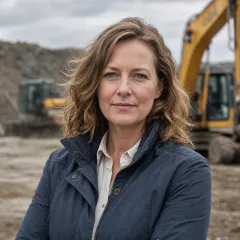
Last spring, I was kneeling next to a machine in the lot with grease up to my elbow, trying to read a part number that had been worn flat. Our bucket truck was in the shop. Our John Deere compact track loader—a 325G, I think—was running double duty because of it. And I was about to order the wrong part.
I'm the office administrator for a 40-person paving and site work company. I manage parts ordering—roughly $180,000 a year across six vendors. I report to both operations and finance. That sounds simple until you're the one holding a phone and pretending to know what a carrier roller is.
The day the loader started tracking weird
The operator said the machine was 'pulling left.' He'd already looked under it and described the front roller as worn. We had a new hire on that crew, and the guy who used to coordinate equipment left in 2023, so the machine history wasn't dialed in. I had a photo of a greasy metal cylinder and a vague description.
So I searched the dealer site for 'front roller' for a John Deere compact track loader. I ordered something that looked close. $460. The dealer said two days. The day it arrived, the parts guy said, 'This is a front idler.' It wasn't the part the machine needed. It needed a carrier roller—the one on top of the track frame. The diagram would have shown me that in five seconds.
It took about a week—or rather, five business days if you don't count the weekend—to get the right part. The restocking fee plus shipping was $63. The project crew had to reorder their schedule, and I had to call the client to explain the delay. That call was more painful than the fee.
Everyone told me to verify with the serial number before ordering. I only believed it after eating that wrong part. It was a frustrating lesson, but it stuck.
Where to find John Deere parts diagrams free (and how to use them)
After the fiasco, I asked the dealer if they could send me a diagram. They pointed me to the official John Deere parts catalog. What most people don't realize is that you don't need a dealer login to see the breakdown. You can access John Deere parts diagrams free by searching the model number and selecting your serial number range. It's not just a nice picture—the diagram includes part numbers, names, and sometimes service updates.
Here's how it went for me:
- Go to the John Deere parts catalog site and enter the machine model.
- Select the exact serial number range. This matters more than you'd think, because John Deere sometimes changes a part mid-production.
- Open the 'Undercarriage' or 'Track Frame' category.
- Zoom in on the diagram and find the part that actually matches what's in front of you.
- Write down the part number, not just the name.
When I compared the front idler and the carrier roller side by side, I finally understood why details matter. They're both 'wheels,' kind of, but the mounting is different. The old carrier roller had a grease fitting sticking out at an angle. The front idler didn't. The photo I took from the ground made them look similar. Put another way: I was basically using a headcanon generator in my own head—inventing a plausible story about a part instead of confirming what was actually there.
I want to say the undercarriage section had about 40 part numbers, but don't quote me on that. The point is, the diagram turned a guess into a spec. Since then, I've ordered dozens of parts by diagram and only missed once, because I didn't catch the updated serial number range.
The side quest: how to get forklift certification
This all happened while our annual safety audit flagged our forklift records. The warehouse foreman was certified in 2021, but he left, and nobody kept the paperwork current. So I also had to figure out how to get forklift certification for myself and two warehouse staff—because we couldn't keep operating on one reliable certified person.
I called our insurance carrier and got a few names. The thing to know is that OSHA doesn't require a specific school. It requires training based on 29 CFR 1910.178(l), including both classroom instruction and a practical evaluation on the forklift. Most providers issue a certificate for three years, which is how employers typically track the OSHA requirement to re-evaluate at least every three years.
Here's what I learned about how to get forklift certification without losing your whole week:
- Look for a local safety council or community college that offers a one-day forklift certification course.
- Make sure the course includes a practical driving evaluation, not just a video.
- If you have enough employees, an in-house trainer can be cheaper, but you need someone qualified to design the evaluation.
- Budget for it. As of early 2025, I found courses around $150 to $300 per person in our area.
The training ended up being pretty straightforward. I actually enjoyed the hands-on part. But the reason it mattered was the same reason the parts diagram mattered: it's a small thing that keeps the whole operation from looking like a mess.
What this taught me about quality and brand
I have mixed feelings about OEM parts. On one hand, I've looked at a John Deere bracket and asked why it costs $200. On the other hand, the exact carrier roller from the diagram made the compact track loader track straight again, and the machine didn't have to come back for the same issue. The cheaper alternative I almost ordered would have probably worked, but I wasn't going to be the person who explains another week of downtime to save $80.
That's where the quality perception piece comes in. Clients don't see the part number. They see a machine tracking straight across their property. They see a company that shows up on time and doesn't miss a day because someone ordered the wrong part. They see the paperwork in the office and assume it's equally organized. If the equipment looks ragged or the safety training is expired, the whole brand takes a hit.
I'm not saying you should never buy aftermarket parts. For some wear items, it's fine. But for critical undercarriage components on a tracked machine, I now use the official diagram to confirm the original part number before I compare anything. That process is free, and it saves me from guessing.
The equipment is the brand. The order process is the foundation. And the faster you stop guessing, the better your company looks to the customer.
Two years ago, I would have called this a boring part of the job. Now I think it's one of the most underrated pieces of running a good operation. The free diagram wasn't just a convenience. It was the difference between acting like a professional and hoping I looked like one.